
Funny Table Topics prompts give an impromptu speaker a playful situation and a clear way into it. A good prompt invites a story or argument without making the volunteer the joke. Use the questions below with a visible timekeeper and an easy option to pass.
Contents
Twenty prompts to try
- Defend the world’s least useful superpower.
- Give a retirement speech for your old phone.
- Explain why your houseplant should be promoted.
- Pitch a holiday devoted to unfinished to-do lists.
- Describe the customer service policy of a dragon-run hotel.
- Give directions to someone who has never seen a roundabout.
- Argue that socks should be sold one at a time.
- Introduce a museum exhibit about your Monday morning.
- Invent a new rule for elevator small talk.
- Apologize on behalf of a weather forecast.
- Explain why your imaginary pet is running for office.
- Sell a backpack designed for people who pack too much.
- Announce a breakthrough in the science of finding keys.
- Accept an award for a skill nobody knew you had.
- Convince a committee to rename the weekend.
- Review a restaurant where the menu is only questions.
- Present the safety briefing for a trip to the moon.
- Describe the sport you invented in a queue.
- Make a case for bringing back an absurd fashion trend.
- Explain the etiquette of meeting your future self.
Absurd job interviews
- Apply to be the official tester of park benches.
- Explain why you are qualified to manage a cloud's schedule.
- Interview for the role of chief lost-sock investigator.
- Pitch yourself as a professional queue improver.
- Describe your first day as a museum's silence consultant.
- Convince a hiring panel you can translate cat complaints.
- Explain why a lighthouse needs a social media manager.
- Apply to supervise the world's smallest parade.
- Tell us how you would train a forgetful treasure hunter.
- Make a case for becoming a professional surprise planner.
- Explain your strategy as chief umbrella inspector.
- Describe the interview for a job naming new colors.
- Pitch a role as a referee for family board games.
- Tell us why you should lead a committee on snacks.
- Explain how you would coach a nervous magician.
- Apply to be the first librarian on the moon.
- Describe how you would manage a hotel for time travelers.
- Convince us that you can direct traffic for migrating birds.
- Explain your qualifications as an apology speechwriter for robots.
- Pitch yourself as a consultant for awkward silences.
Strange product pitches
- Sell a clock that tells you when to take a break.
- Introduce shoes that politely ask for a walk.
- Pitch a suitcase that refuses unnecessary items.
- Advertise a notebook for ideas that arrive in the shower.
- Sell a chair designed for people who cannot sit still.
- Introduce a map that marks the best places to daydream.
- Pitch a cup that reminds people to put it down.
- Advertise a coat with pockets for every season.
- Sell a calendar that celebrates unfinished projects.
- Introduce a doorbell for people who prefer a text.
- Pitch a lamp that changes color when you need a snack.
- Advertise a pencil that offers helpful criticism.
- Sell a hat that helps you remember names.
- Introduce a bookcase that recommends the wrong genre on purpose.
- Pitch a bicycle bell with a very formal voice.
- Advertise a plant pot that negotiates watering times.
- Sell a blanket for serious brainstorming sessions.
- Introduce a device that finds the last biscuit.
- Pitch a backpack that packs itself badly but enthusiastically.
- Advertise a mirror that gives practical presentation feedback.
Imaginary public announcements
- Announce a new national holiday for returning borrowed pens.
- Explain a town rule requiring one compliment per bus ride.
- Launch a museum of forgotten passwords.
- Introduce a festival for quiet achievements.
- Explain why the town clock will run five minutes early.
- Announce a competition for the best apology to a houseplant.
- Describe a new bus route chosen by a dog.
- Introduce a library section for books people meant to read.
- Explain the grand opening of a very small park.
- Announce a citywide search for the perfect sandwich name.
- Introduce a weather service that gives emotional advice.
- Explain why all street signs now include a question.
- Announce a new award for patient people in queues.
- Introduce the first official day of doing one thing at a time.
- Explain a town plan to give every bench a biography.
- Announce a parade where the audience marches and the band watches.
- Introduce a public hotline for minor everyday mysteries.
- Explain a new rule for naming office meeting rooms.
- Announce a library fine paid in useful book recommendations.
- Introduce a local election for the most helpful pigeon.
Unexpected speeches
- Give a wedding toast for two matching socks.
- Deliver a farewell speech to an old alarm clock.
- Thank a staircase for its years of service.
- Apologize to a map for ignoring its advice.
- Give a pep talk to a nervous umbrella.
- Accept a lifetime achievement award for making toast.
- Introduce a keynote speaker who is a houseplant.
- Give a eulogy for a broken remote control.
- Thank your future self for labeling a box.
- Persuade a spoon that it has an exciting career ahead.
- Give a graduation speech to a class of rubber ducks.
- Announce your candidacy for neighborhood nap coordinator.
- Explain why your refrigerator deserves a promotion.
- Give a motivational talk to a stalled printer.
- Celebrate the retirement of an overworked bookmark.
- Explain to visitors why your town worships a traffic cone.
- Give a serious review of an imaginary invisible restaurant.
- Thank a pair of shoes for a journey they did not choose.
- Convince a cactus to join a gardening club.
- Deliver a victory speech for finding your keys.
Two-minute dilemmas
- You can speak to one animal for a day; which one and why?
- Your bag produces one useful object each morning; what do you request?
- A robot copies one of your habits; which habit do you teach it?
- You must rename Monday; what name would improve it?
- A museum will preserve one item from your desk; which item wins?
- You can add one room to every public library; what is it?
- Your future self sends a postcard with three words; what do they say?
- You may change one sound in your town; what do you choose?
- A friendly alien asks why people queue; how do you explain it?
- You must defend a new sport using only office supplies.
- You can give one household object a holiday; which one?
- A magic button can pause one daily annoyance; what do you pause?
- You inherit a café with one unusual rule; what is it?
- Your phone can ask one question a day; what should it ask?
- You must choose a theme song for a supermarket aisle.
- You can teach a cloud one skill; what would be useful?
- Your town asks you to design a monument to patience.
- You must replace a common greeting with a better one.
- You can make one chore into a game; how does it work?
- A time traveler needs your advice about modern meetings.
Run a fair round
Read the prompt slowly, then give the speaker a few seconds to think. For a novice, offer a choice of two prompts. Keep the timekeeper visible and make passing acceptable. A host can say, “Choose a position, give one example, and end with a punchline or lesson.”
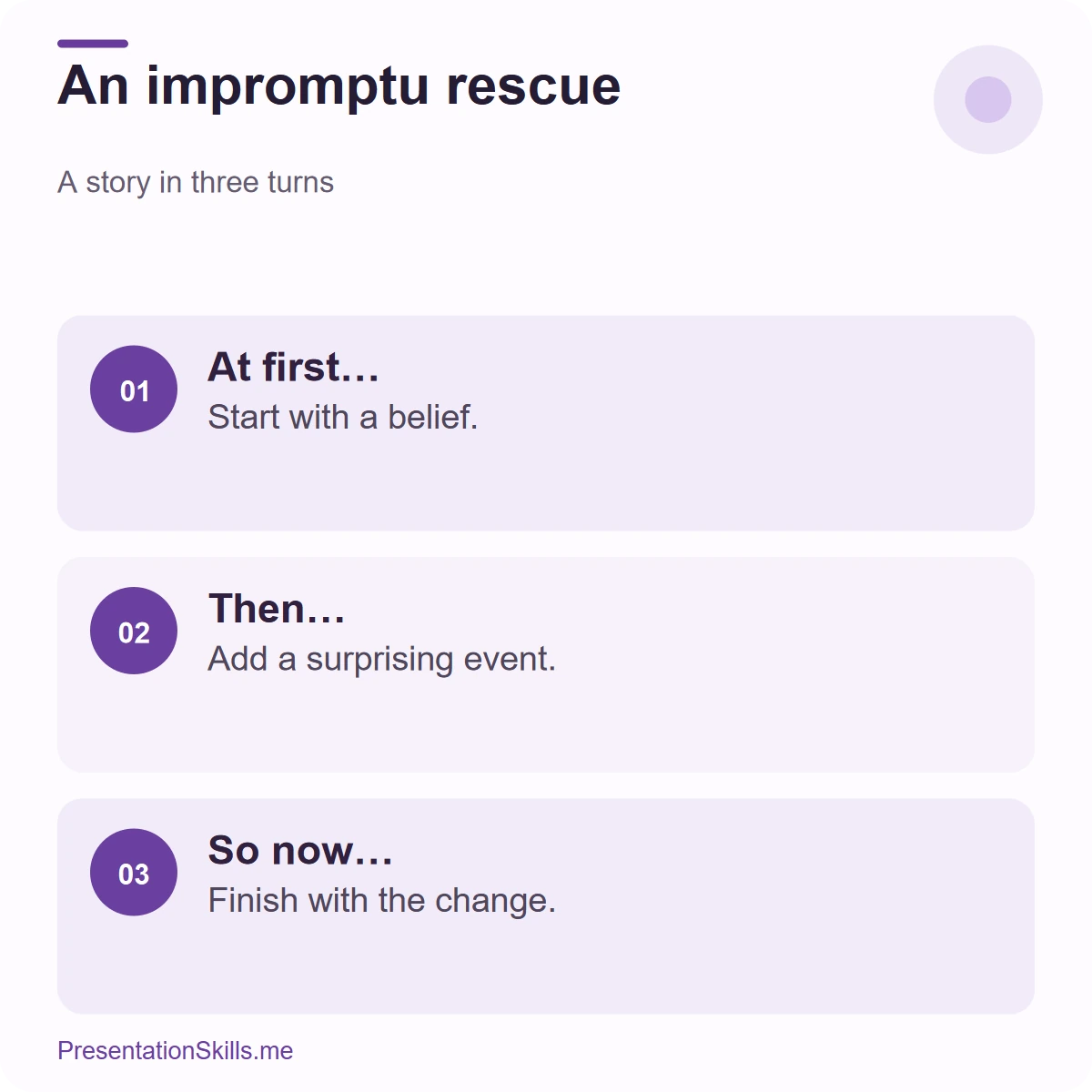
One-minute rescue structure: “At first I thought… Then something happened… So now I believe…” It works for serious and silly topics alike.
After each response, applaud the idea the speaker developed, not just the joke. For a wider range of impromptu prompts, see our Table Topics question collection.
Prepare the room for playful answers
Mix broad and specific prompts so different speakers can find an angle. A speaker who loves storytelling may enjoy the imaginary hotel; another may prefer defending a silly policy. Do not spring a prompt that relies on embarrassing the speaker or asking for private details. The audience should be laughing with the idea, not at the person.
If the round is part of a meeting, put the prompt on a card and keep a spare. A speaker may mishear an elaborate question. Read it once, show it briefly, then start the clock after they have had a moment to choose their opening line.