
Choose a team-meeting topic by the outcome you need: learning, a decision, or a change in how the team works. Send a focused question in advance, ask for examples, and record the decision and owner at the end. The prompts below are designed around those outcomes.
Contents
Topics for learning
- Which recent handoff caused the most rework, and why?
- What did a customer do that surprised us?
- Which assumption did last month’s results challenge?
- What is one practice another team uses that we should test?
- Where are we relying on one person’s undocumented knowledge?
Topics for decisions
- Which two priorities are competing for the same time?
- What is the smallest experiment that would reduce uncertainty?
- What should we stop doing before we add another task?
- Which risk are we willing to accept, and who owns it?
- What evidence would change today’s decision?
Topics for team health
- Which meeting could become an async update?
- Where do people wait too long for an answer?
- What part of our process feels unclear to a new colleague?
- Which recent win deserves more attention?
- How can we make it easier to disagree early?
Planning the next cycle
- Which result matters most by the end of this month?
- What work must be finished before another task can begin?
- Where is our current plan too optimistic?
- Which deadline has the weakest owner?
- What would we remove if capacity dropped by a quarter?
- Which task needs a clearer definition of done?
- What information should we gather before committing?
- Where can a small test replace a large promise?
- Which milestone should customers see first?
- What part of the plan depends on one person?
- What should we prepare if a supplier is late?
- How will we know this cycle is on track next week?
- Which decision can wait until we have evidence?
- What should we communicate outside the team now?
- Where would a template save repeated work?
- What is the first sign that scope is expanding?
- Which meeting can we remove from the plan?
- What must be reviewed before a release?
- What would a successful handoff look like?
Customer and audience understanding
- What question do customers ask before they understand the product?
- Which complaint points to a confusing promise?
- Where do new users hesitate most often?
- What customer behavior surprised us recently?
- Which group have we not heard from?
- What does our support team explain repeatedly?
- Where does our documentation assume too much knowledge?
- Which feedback is common but still poorly understood?
- How could we test a simpler instruction?
- What would help a first-time user succeed faster?
- Which customer need has changed since we last reviewed it?
- What is one request we should decline and explain clearly?
- Where are customers doing extra work to use our service?
- What question should we ask in the next interview?
- Which audience segment needs a different example?
- What result do customers actually notice?
- Which help page needs a better screenshot or diagram?
- What would make a complaint easier to resolve?
- Which assumption about the customer is least supported?
- How can we close the loop on feedback we received?
Process and handoffs
- Where does a task wait longest between people?
- Which approval step rarely changes the outcome?
- What information is missing from the usual handoff?
- How do we know when a document is final?
- Which recurring error could a checklist prevent?
- Where do two teams use different names for the same thing?
- What should be automated only after the process is clear?
- Which task needs a single owner rather than a group?
- Where do people copy data unnecessarily?
- How can we make changes visible without another meeting?
- Which exception does our standard process ignore?
- What should happen when a request arrives incomplete?
- Where is our shared folder difficult to navigate?
- Which handoff would benefit from a short example?
- What can we learn from the smoothest recent delivery?
- Who needs to be informed but not asked to approve?
- How should we record a temporary workaround?
- Where do we rely on memory instead of a visible system?
- What is one step we can remove safely?
- How will we test whether a process change helped?
Decisions and trade-offs
- What choice has the largest effect on users?
- Which option is easiest to reverse?
- What cost are we leaving out of the discussion?
- What evidence would change the recommendation?
- Who will maintain this choice after launch?
- Which option solves the immediate problem but creates another?
- How should we decide when speed and quality conflict?
- What would the simplest acceptable version be?
- Which stakeholder has not seen the alternatives?
- What risk are we accepting intentionally?
- What should we write down about this decision?
- When would we revisit the choice?
- Which metric might reward the wrong behavior?
- What is the downside of doing nothing for one month?
- Where could a pilot settle the argument?
- What do we gain by delaying this decision?
- Which option can we explain most honestly to customers?
- What would a skeptical colleague ask first?
- Which dependency makes one option less realistic?
- What should we stop doing if this becomes the priority?
Team learning and feedback
- Which recent mistake revealed a weak process?
- What did a colleague teach you this week?
- Where did we learn something too late?
- What worked well that we have not documented?
- Which feedback did we act on, and what happened?
- What should a new teammate know on day one?
- Which meeting habit helps quieter people contribute?
- Where do we need more direct disagreement?
- What should we ask another team to show us?
- Which task would benefit from pairing?
- What assumption did a small experiment challenge?
- How can we give feedback earlier in a project?
- What was unnecessarily difficult this week?
- Which repeated question deserves a shared answer?
- What should we keep from the last project cycle?
- Where did our estimate miss the real work?
- What is one skill the team should practice together?
- What made a recent decision easier than expected?
- Which success depended on work few people saw?
- How should we review an experiment that failed?
Meeting quality and communication
- Which topic needs discussion, and which needs a written update?
- What should participants read before the next meeting?
- Where does our agenda hide the actual decision?
- How can we close a meeting with clearer actions?
- Which recurring meeting could be shorter?
- What should we ask people to prepare in one sentence?
Use a decision log
Question: ___ Options considered: ___ Evidence: ___ Decision and reason: ___ Owner: ___ Review date: ___
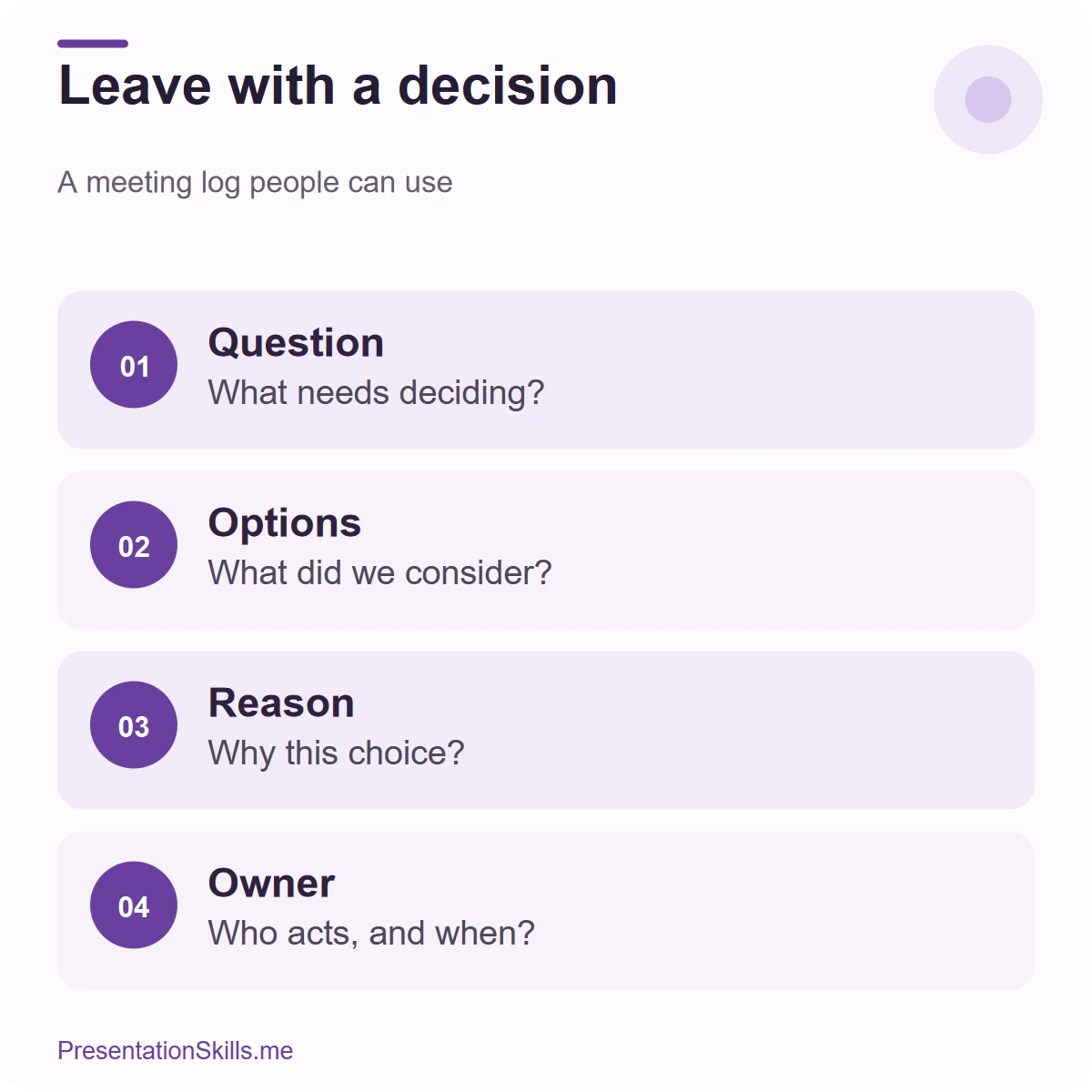
Send the question before the meeting and ask people to bring one example. Spend the first few minutes hearing observations, then compare options, then decide who does what. If the group lacks evidence, assign a small investigation rather than filling the hour with guesses. Our business discussion topics offer more prompts when a wider group is involved.
Make the question actionable
Replace “How is the project going?” with “Which dependency is most likely to delay Friday’s handoff?” The second question tells people what evidence to bring and makes an owner easier to assign. If you want a creative discussion, set a boundary: “What could we change in two weeks without extra budget?” Constraints can make ideas more useful.
At the end, read the decision and next action aloud. Give someone the job of circulating the log. The quality of a meeting is easier to judge a week later, when you can see whether the agreed action happened.